I remember the morning I opened my news feed and saw three major AI announcements within an hour. A new model had surpassed human performance on a medical licensing exam. A regulatory body had issued its first enforcement action against an AI vendor. A startup had raised a billion dollars to build autonomous agents. Any one of these stories would have dominated the technology news cycle a few years ago. In 2026, they arrived simultaneously, competing for attention in an already crowded landscape.
Keeping up with AI news and trends has become a discipline in itself. The volume of developments is overwhelming, the pace of change is relentless, and the implications of individual stories are often unclear until viewed in a broader context. For professionals, investors, policymakers, and informed citizens, understanding what is actually happening, and what matters, requires more than passive consumption. It requires a framework for evaluating news, identifying genuine trends, and distinguishing meaningful developments from marketing noise.
This article provides a comprehensive overview of the major AI news and trends defining 2026. We will examine technological breakthroughs, market dynamics, regulatory developments, and societal impacts. My goal is to help you understand not just what is happening, but why it matters and what it means for the future.
The AI Market in 2026: Scale, Growth, and Investment
The financial dimensions of AI tell their own story about where the industry is heading. The numbers are staggering, but they also reveal patterns that help distinguish hype from substance.
Market Expansion
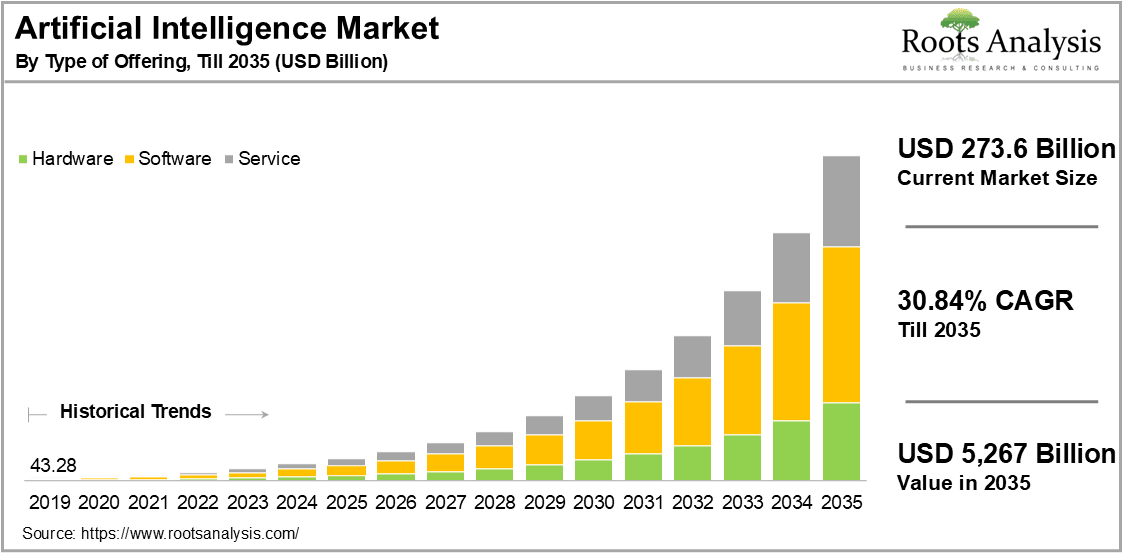
The global artificial intelligence market has grown exponentially over the past decade. According to industry analysis, the market is projected to reach approximately $273.6 billion in 2026, with forecasts suggesting it could grow to over $5.2 trillion by 2035. This represents a compound annual growth rate of nearly 31 percent, a pace that few industries in history have sustained.
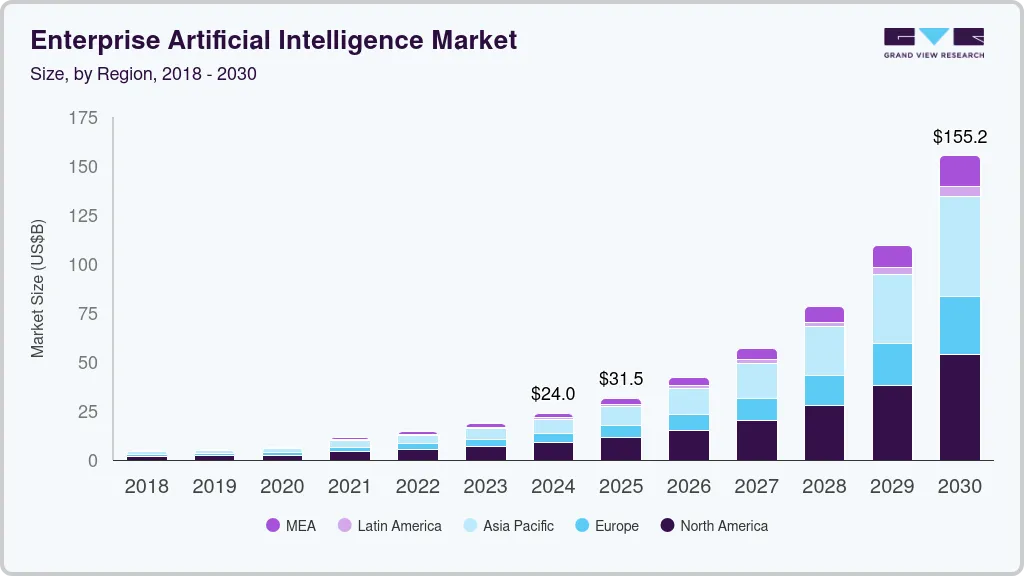
What is driving this growth is not just consumer applications but deep enterprise adoption. Businesses across every sector are integrating AI into core operations, from customer service and supply chain management to product development and strategic planning. The enterprise AI market alone is projected to reach $155 billion by 2030, with North America and Asia-Pacific leading regional adoption.
Record Investment Levels
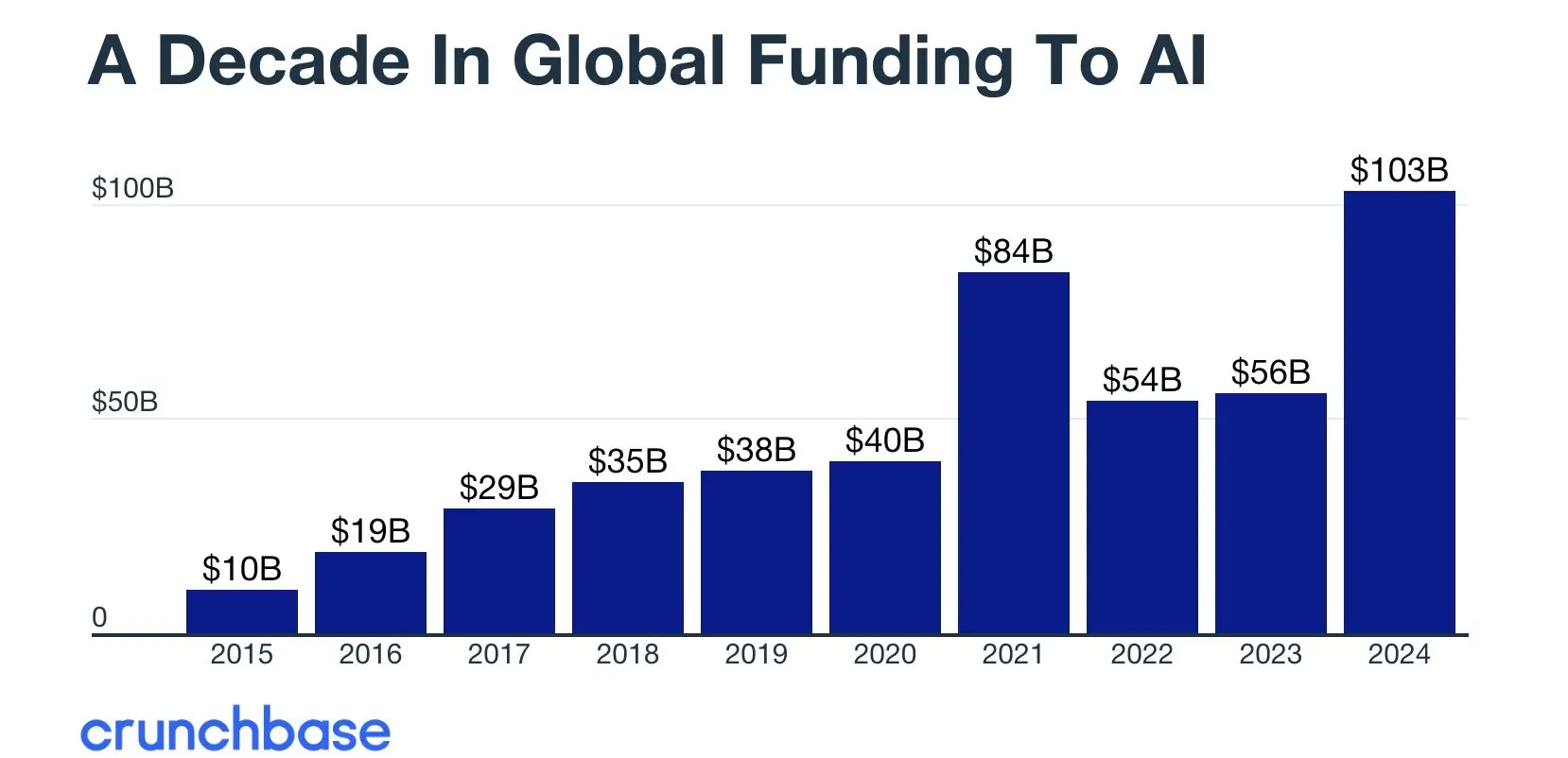
Venture capital investment in AI startups reached unprecedented levels in recent years. According to Crunchbase data, global AI funding hit $103 billion in 2024, nearly doubling from the previous year and representing a tenfold increase from a decade earlier. This surge reflects both genuine technological progress and significant capital allocation toward what investors perceive as the next foundational platform.
However, the investment climate is becoming more selective. After years of funding growth at all costs, investors are increasingly demanding clear paths to profitability, sustainable business models, and demonstrated customer value. The era of easy capital for any company with “AI” in its pitch deck is fading. The companies that thrive will be those that solve real problems for real customers.
Where Businesses Are Actually Using AI
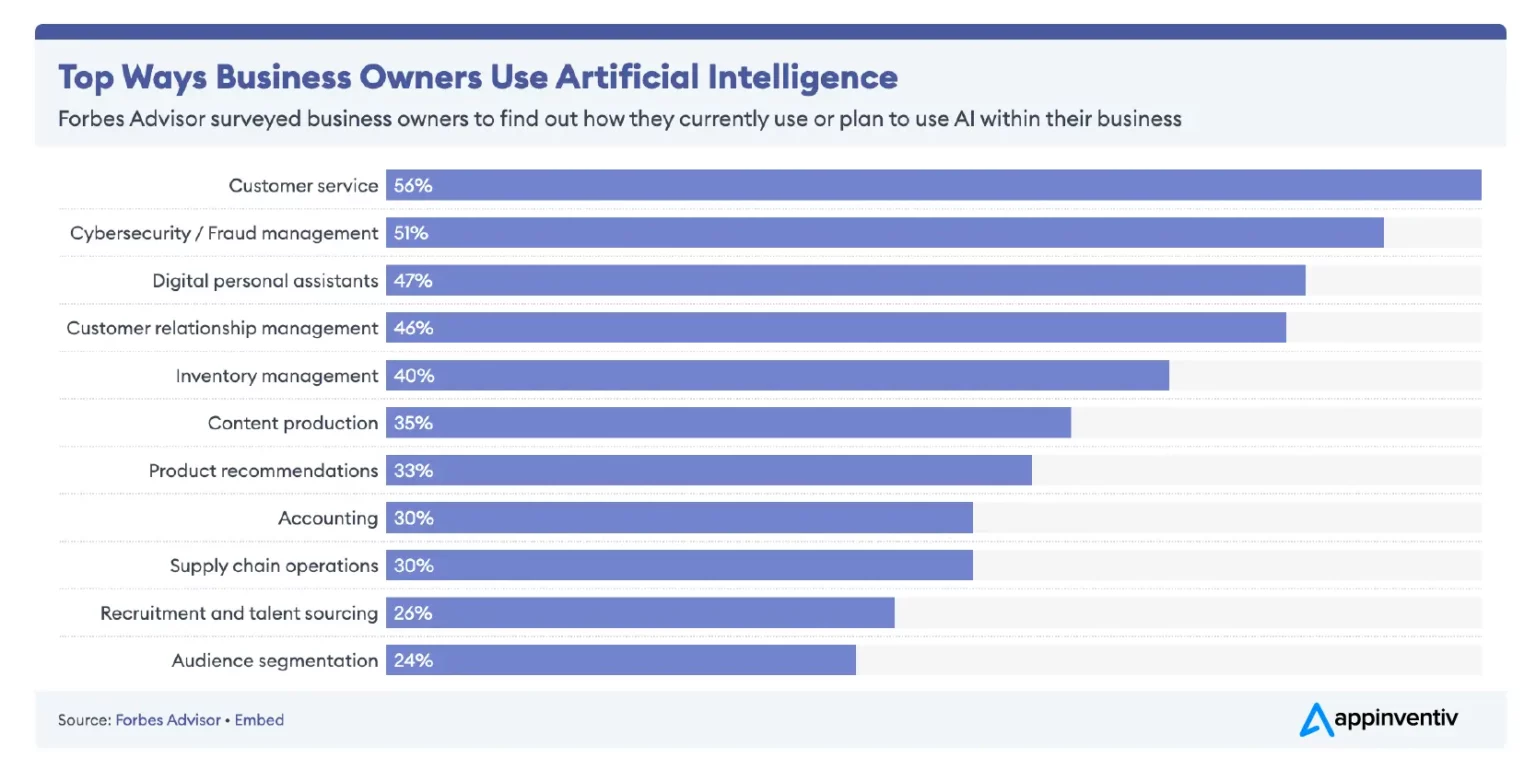
Forbes Advisor research reveals how business owners are currently deploying AI across their operations. Customer service leads adoption at 56 percent, followed by cybersecurity and fraud management at 51 percent. Digital personal assistants, customer relationship management, and inventory management each claim significant adoption rates between 40 and 47 percent.
These numbers matter because they show where AI is delivering practical value today, not where it might deliver value tomorrow. Customer service automation, threat detection, and operational efficiency are concrete use cases with measurable returns. This grounded adoption contrasts with more speculative applications that generate headlines but have not yet achieved mainstream deployment.
The Technology Landscape: What Is Actually New
Beneath the market numbers, the technology itself continues to evolve rapidly. Understanding the specific technical developments helps separate genuine progress from repackaged capabilities.
The Latest Developments You Need to Know
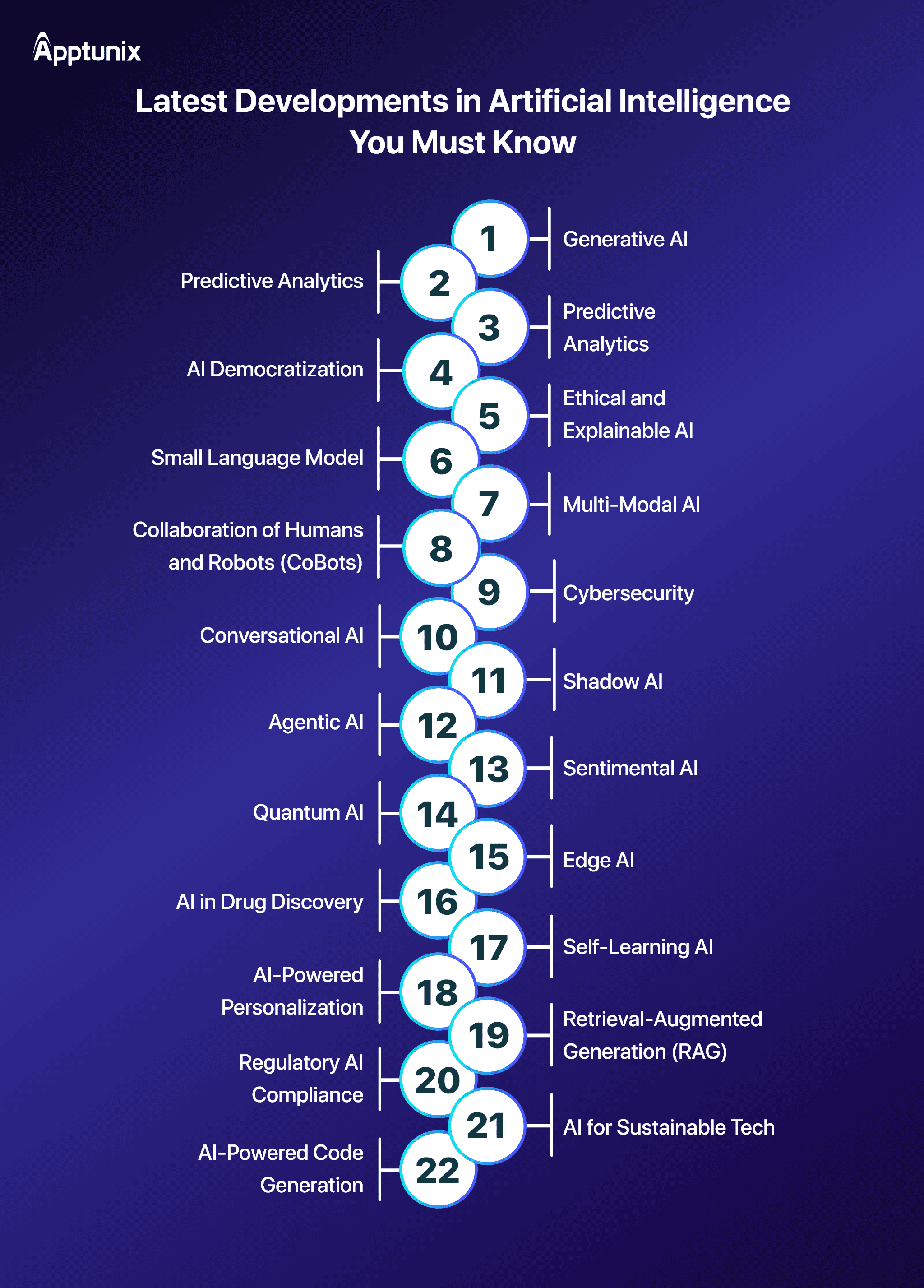
The current AI technology landscape encompasses over twenty significant developments that are reshaping how businesses and consumers interact with artificial intelligence. These include:
-
Generative AI continues to mature beyond text and images into video, audio, and multimodal content creation
-
Predictive Analytics has become more sophisticated, enabling businesses to forecast trends with greater accuracy
-
AI Democratization is making advanced tools accessible to non-technical users through intuitive interfaces
-
Ethical and Explainable AI is moving from academic research to practical implementation as regulatory requirements tighten
-
Small Language Models are gaining traction for edge deployment and privacy-sensitive applications
-
Multi-Modal AI processes text, images, audio, and video together for richer understanding
-
Agentic AI can pursue multi-step goals with minimal human intervention
-
Shadow AI refers to unauthorized AI use within organizations, an emerging governance challenge
-
Sentimental AI analyzes emotional states and social sentiment at scale
-
Quantum AI leverages quantum computing for complex optimization problems
-
Edge AI processes data locally rather than in the cloud
-
AI in Drug Discovery is accelerating pharmaceutical research
-
Self-Learning AI improves continuously without explicit retraining
-
Retrieval-Augmented Generation (RAG) grounds AI outputs in verified knowledge bases
-
AI for Sustainable Technology addresses environmental challenges
-
AI-Powered Code Generation continues to transform software development
The 2026 Timeline: Major Trends by Quarter
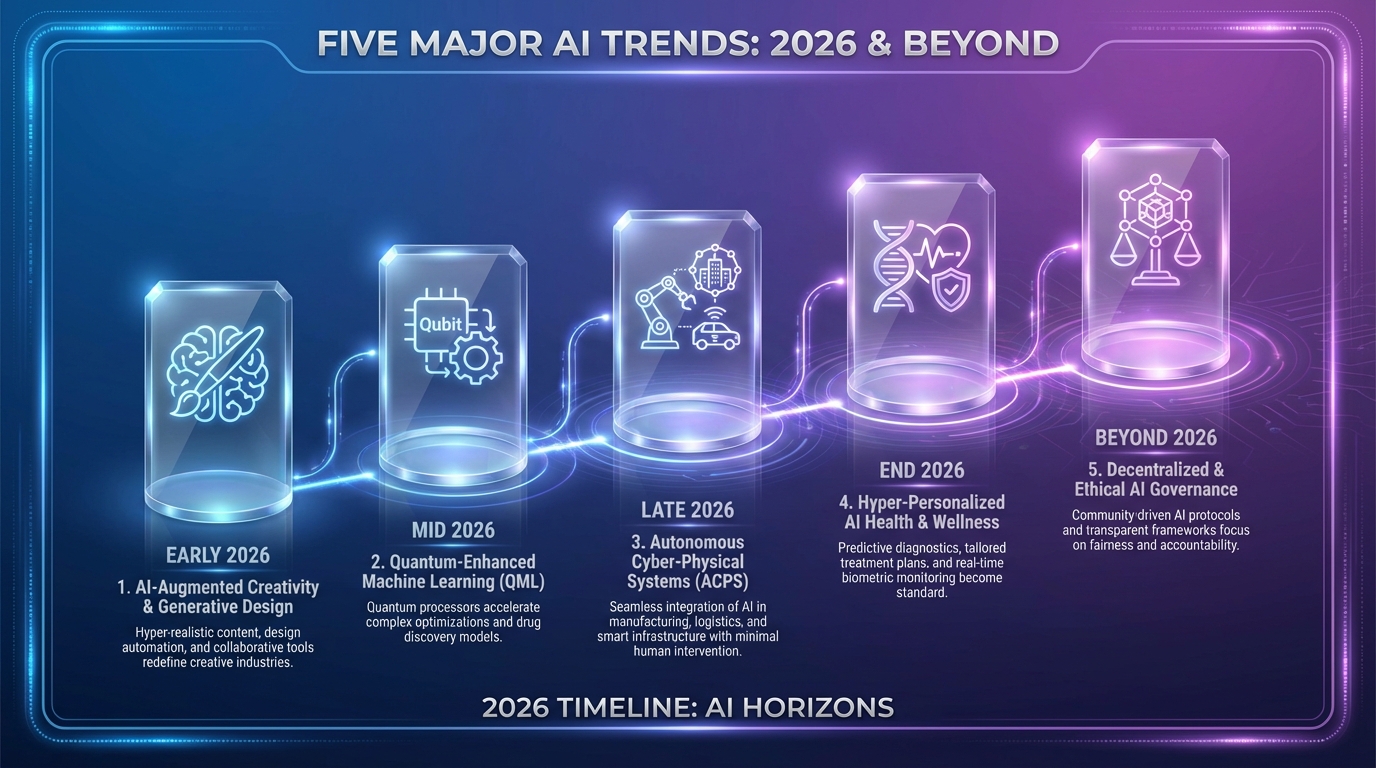
Looking at the year ahead, industry observers have mapped a timeline of emerging capabilities:
Early 2026 sees AI-augmented creativity and generative design reaching new levels of sophistication. Hyper-realistic content generation, design automation, and collaborative creative tools are redefining industries from advertising to architecture.
Mid 2026 brings quantum-enhanced machine learning into practical applications. Quantum processors are beginning to accelerate complex optimizations and drug discovery models that classical computers struggle with.
Late 2026 marks the emergence of autonomous cyber-physical systems. Manufacturing, logistics, and smart infrastructure are seeing seamless AI integration with minimal human intervention.
End of 2026 ushers in hyper-personalized AI health and wellness. Predictive diagnostics, tailored treatment plans, and real-time biometric monitoring are becoming standard capabilities.
Beyond 2026, the focus shifts toward decentralized and ethical AI governance. Community-driven AI protocols and transparent frameworks are prioritizing fairness and accountability in system design.
Regulatory and Policy Developments
As AI capabilities grow, so does the regulatory response. 2026 is a pivotal year for AI governance, with significant policy shifts taking shape across major jurisdictions.
Global Regulatory Momentum
The regulatory landscape for AI has accelerated dramatically. The European Union’s AI Act has moved from framework to enforcement, with the first significant penalties issued against non-compliant systems. The United States has developed a more detailed federal approach through executive orders and agency guidance, while maintaining a lighter touch than Brussels in some areas.
China continues to implement its own regulatory model, emphasizing state oversight and alignment with national priorities. Meanwhile, countries in the Global South are developing frameworks that balance innovation incentives with protection against exploitation.
Seven Major Policy Shifts
Industry analysts have identified seven critical regulatory developments shaping the AI landscape in 2026:
-
Mandatory risk assessments for high-stakes AI applications before deployment
-
Transparency requirements forcing companies to disclose when AI is used in decision-making
-
Data sovereignty rules restricting cross-border data flows for AI training
-
Liability frameworks establishing clear accountability when AI systems cause harm
-
Algorithmic auditing standards requiring independent verification of AI fairness and accuracy
-
Workforce transition protections supporting workers displaced by automation
-
International cooperation mechanisms for addressing AI safety and security threats
These policy shifts are creating a new compliance landscape for AI developers and users. Companies that treat regulation as an afterthought are facing enforcement actions, fines, and reputational damage. Those that build compliance into their development processes from the beginning are gaining competitive advantages.

Enterprise Adoption: From Experiment to Infrastructure
Perhaps the most significant trend in 2026 is the normalization of AI within enterprise operations. The question is no longer whether to adopt AI, but how deeply to integrate it.
The Scale of Adoption
Large enterprises report AI adoption rates exceeding eighty percent in some sectors. What is more striking is the acceleration among mid-market companies and even small businesses. Cloud-based, subscription-model AI tools have democratized access to capabilities that were once reserved for tech giants with massive research budgets.
The applications are diverse and growing. Marketing teams use AI for content generation and audience segmentation. Finance departments deploy AI for fraud detection and risk modeling. Operations teams leverage predictive maintenance and supply chain optimization. Human resources uses AI for candidate screening and employee engagement analysis.
From Pilots to Production
The conversation in boardrooms has shifted from proof-of-concept to production-grade deployment. Executives want to know not whether AI works, but whether it can scale reliably, comply with regulations, integrate with legacy systems, and deliver measurable return on investment.
This operationalization phase is creating demand for new roles and capabilities. AI operations engineers, ethics officers, and model governance specialists are becoming standard positions in enterprise organizations. The focus is shifting from building models to managing them in production environments.
AI in Marketing: A Case Study in Sector Transformation
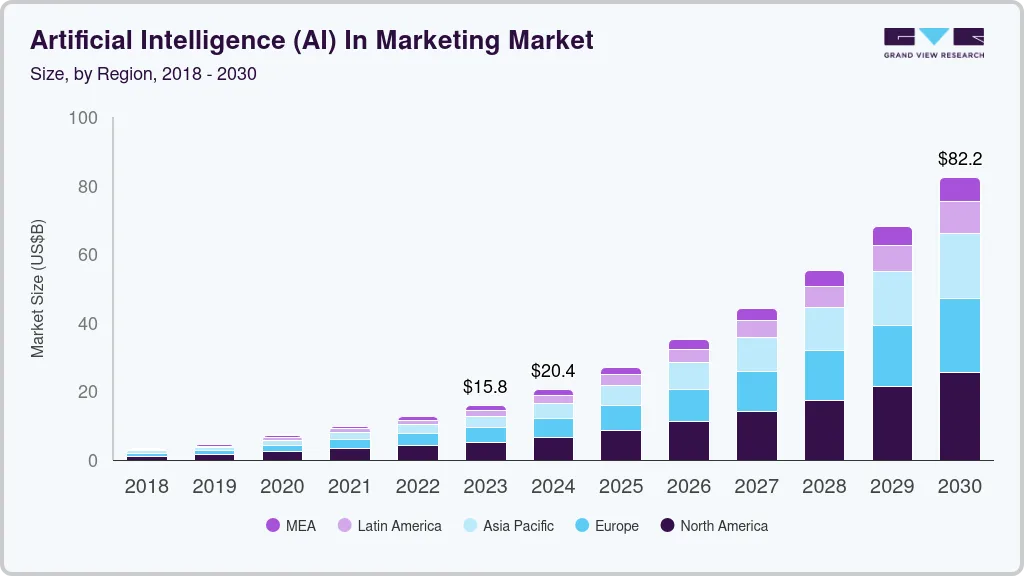
The marketing industry illustrates how AI is transforming specific sectors. The AI in marketing market is projected to grow from $20.4 billion in 2024 to over $82 billion by 2030, reflecting the deep integration of AI into how businesses reach and engage customers.
Key Applications
AI is now embedded across the marketing funnel. Predictive analytics identifies high-value prospects. Content generation tools produce personalized messaging at scale. Recommendation engines optimize product suggestions. Sentiment analysis monitors brand perception in real time. Attribution modeling determines which marketing investments drive results.
The Shift From Mass to Micro
Perhaps the most profound change is the shift from mass marketing to micro-personalization. AI enables businesses to tailor messaging, offers, and experiences to individual customers based on their behavior, preferences, and predicted needs. This level of personalization was theoretically possible before AI, but only at prohibitive cost and scale.
The challenge is maintaining authenticity and trust. Customers appreciate relevance but recoil from creepiness. The brands that succeed are those that use AI to enhance customer experience without crossing into invasive surveillance.
Common Mistakes When Following AI News
The volume and velocity of AI news create specific hazards for those trying to stay informed.
Confusing Announcements With Availability
Technology companies announce capabilities months or years before they are practically available. A research breakthrough or product announcement is not the same as a tool you can use today. Distinguish between what exists, what is coming, and what is merely aspirational.
Overweighting Single Stories
A dramatic AI story, a model passing an exam, a robot performing a task, a prediction of imminent job loss, can distort your understanding of the broader landscape. No single story defines the field. Look for patterns across multiple sources and timeframes.
Ignoring the Business Context
Technical capability is only one dimension. Regulatory constraints, market demand, competitive dynamics, and implementation challenges determine whether an innovation succeeds. The technically superior solution often loses to the one with better distribution, pricing, or timing.
Dismissing AI as Pure Hype
The opposite mistake is also common. Some observers, burned by earlier hype cycles, dismiss all AI progress as marketing. This blind spot leaves them unprepared for genuine disruptions that reshape their industries. Maintain skepticism without becoming cynical.
How to Stay Informed Without Being Overwhelmed
Given the volume of AI news, a strategic approach to information consumption is essential.
Curate your sources ruthlessly. Choose a small number of high-quality publications, newsletters, and analysts. I follow three primary AI news sources and one general technology outlet. That is enough to stay informed without constant scrolling.
Focus on your domain. If you work in healthcare, prioritize medical AI developments. If you are in finance, follow fintech AI. Domain-specific knowledge is more actionable than general awareness.
Set a weekly review habit. Rather than checking news constantly, dedicate one focused hour per week to reading and reflecting. This prevents reactive consumption and allows deeper thinking.
Track leading indicators. Pay attention to funding patterns, regulatory filings, patent applications, and hiring trends. These often signal developments before they become mainstream news.
Discuss with peers. Join communities where people analyze trends together. Collective intelligence surfaces insights that individual reading misses.
Frequently Asked Questions
How fast is AI actually changing?
The pace varies by sector. Technology, media, and finance are moving fastest. Manufacturing, healthcare, and education are adopting more gradually due to regulatory and infrastructure constraints. Overall, the trend is accelerating as tools become more accessible and proven.
Should I be worried about AI regulation stifling innovation?
Thoughtful regulation often supports innovation by creating clear rules and building public trust. The risk is poorly designed regulation that creates compliance burdens without improving safety. Engaging with policy discussions and supporting evidence-based frameworks is the best response.
Is the AI investment boom sustainable?
Some consolidation is likely as investors become more selective. However, the underlying demand for AI capabilities is real and growing. Companies with genuine value propositions will thrive. Those built purely on hype may struggle. This is a maturation process, not necessarily a collapse.
How can small businesses keep up with AI trends?
Many AI tools now offer affordable subscription tiers designed for small business users. Start with specific problems, such as customer communication or data analysis, and explore tools designed for your scale. The barrier to entry has never been lower.
What is the most important AI trend to watch right now?
The operationalization of AI, how it moves from experiments to core infrastructure, is the most consequential trend. It determines which companies gain sustainable competitive advantages and which fall behind.
Final Thoughts
The AI news landscape of 2026 is rich, complex, and occasionally overwhelming. But beneath the headlines and hype cycles, genuine transformation is occurring. Businesses are integrating AI into their core operations. Regulators are establishing frameworks that will shape development for decades. Investors are separating sustainable value from speculative excitement. And individuals are finding new ways to work, create, and solve problems with intelligent assistance.
The key to navigating this landscape is not to track every development, but to develop a framework for understanding what matters. Focus on trends that affect your domain. Distinguish between announcements and realities. Maintain healthy skepticism without becoming dismissive. And engage with the ethical and policy dimensions that will determine whether AI serves broad human flourishing or narrow interests.
The story of AI in 2026 is still being written. Informed observers who think critically, act strategically, and engage responsibly have the best chance of helping shape it.